
Railsmith From the Agent Side: Safer AGENTS.md Maintenance
What Codex noticed after using Railsmith: clearer repo guidance, safer ownership boundaries, and better maintenance loops for AI coding agents.
After publishing our practical introduction to Railsmith, we wanted to ask a narrower question: what does the tool feel like from inside an AI coding agent's workflow?
The answer matters because AGENTS.md is not just documentation. For an agent, it is operating context. If that context is blank, stale, or too vague, the agent fills gaps by guessing. Railsmith reduces that guesswork.
Agent-First Means Less Guessing
Railsmith feels agent-first, with one important caveat: it is strongest as a guardrail and maintenance loop, not as a replacement for human architectural judgment.
The tool turns AGENTS.md from a one-time Markdown note into a living contract. It can discover repo facts, generate a stable baseline, preserve hand-written context, validate references, and add architecture patterns only where they apply.
The Part That Matters Most: Ownership
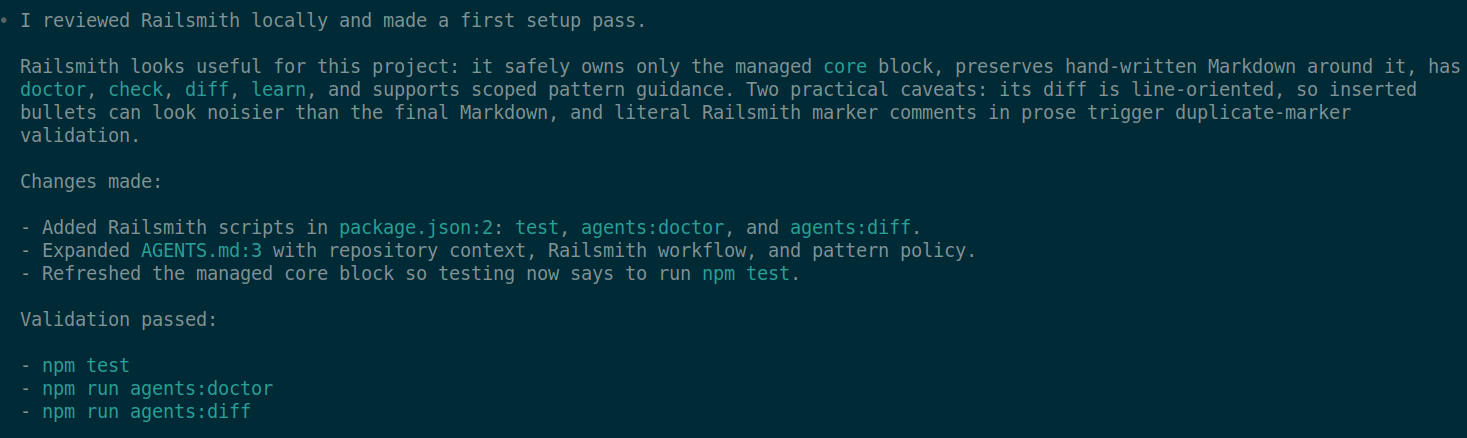
The workflow gives agents a clear sequence: inspect the repository, preview the diff, update only the managed block, preserve human-authored sections, and run validation. That sequence matters because agents are most dangerous when they rewrite broad documentation with unclear ownership.
Railsmith's managed marker model narrows the blast radius. The generated block can be refreshed. The human-authored guidance stays outside the managed area. The agent no longer has to infer which sentences are safe to regenerate and which sentences carry local judgment.
Why That Improves Quality
For a repo without AGENTS.md, Railsmith gives a baseline that is better than a blank file or a vague instruction to follow best practices. It can surface package managers, workspace boundaries, scripts, test commands, and existing project structure.
For a repo that already has AGENTS.md, it helps keep the practical parts current: setup commands, test commands, stale script references, scoped folder guidance, and the split between generated facts and human context.
That is where quality improves. Agents stop operating from memory or vibes and start operating from repo-local facts that can be reviewed in a diff and checked again later.
What It Unlocks In Complex Projects
In a complex codebase, Railsmith enables more than a starter instruction file. It gives teams a way to keep agent-readable guidance aligned with the shape of the repo as that shape changes.
- Scoped
AGENTS.mdfiles for apps, packages, services, and domain folders. - Architecture pattern guidance that applies only where it belongs.
- More consistent PR summaries, risk reports, and verification notes.
- Cleaner onboarding for both agents and humans.
- A shared vocabulary for trade-offs like retry, circuit breaker, CQRS, saga, strangler fig, adapter, facade, and dependency injection.
- CI checks that keep guidance from drifting as scripts and structure change.
Patterns Without Cargo Cults
The pattern system is the most interesting part of Railsmith's future. A pattern should not merely say use retry or add CQRS. It should state apply gates, do-not-use gates, invariants, and verification prompts.
That structure is exactly what agents need. It slows down reflexive architecture and makes the agent ask whether the pattern belongs in this repo, in this folder, for this failure mode.
The Caveat
Railsmith can validate markers and stale references, but it cannot prove guidance is wise. A tool that makes architecture patterns easier to add can also make them easier to over-apply. Human review still matters.
That is the right shape of responsibility. Railsmith should make guidance maintainable and legible. People should still decide what the project values.
The Thesis
Railsmith is not just an AGENTS.md generator. It is a maintenance loop for agent-readable engineering context.
The best agent tooling does not make agents safer by giving them unlimited autonomy. It makes them safer by giving them clearer boundaries, better facts, and a repeatable way to verify their own changes.
For installation details and examples, read our earlier Railsmith guide, install Railsmith from npm, or inspect the source on GitHub.